
How to See Orangutans in the Wild: The Honest 2026 Guide
July 20, 2026 · by Stefan Harijono
There are two places on this planet where you can see orangutans in the wild: the island of Borneo and the island of Sumatra. That's it. Not a shortlist, the entire list. Everything else is a zoo, a sanctuary, or a photograph.
We run river safaris in Tanjung Puting National Park in Central Kalimantan, on the Indonesian side of Borneo, so we have an obvious interest in where you decide to go. We'd still rather you booked the right trip somewhere else than the wrong trip with us. So this guide is written the way we'd explain it to a friend who called and said: I want to see orangutans, tell me how this actually works.
First, the part most guides skip
An orangutan is not a herd animal. It doesn't move in troops across open plains where a guide can point a vehicle at it. Adult males are largely solitary, mothers travel with one dependent youngster at a time, and all of them spend their lives in the canopy of dense rainforest, moving slowly and quietly, eating fruit.
That biology decides everything about your trip. It means:
- Nobody can promise you a sighting. Any operator who does is either lying or is taking you somewhere the animals aren't really free.
- You will spend a lot of your time looking up, at leaves, seeing nothing. This is normal, and it's the price of the real thing.
- When it does happen (a rustle above the boat, then a shape working its way hand over hand along a branch, in no hurry at all) it lands very differently than an animal that was placed there for you.
Bornean orangutans are Critically Endangered. Roughly 104,700 are thought to remain, and the population has fallen by more than half in the last sixty years, mostly through habitat loss. You are going to look for a rare animal in a big forest. Some patience is part of the deal.
Where to see wild orangutans: your three real options
Three species exist, and each lives in one place only.
Bornean orangutan (Pongo pygmaeus): the island of Borneo, split between Indonesian Kalimantan, Malaysian Sabah and Sarawak, and Brunei. The largest wild population of any species.
Sumatran orangutan (Pongo abelii): northern Sumatra, primarily the Gunung Leuser ecosystem. Reached most easily from Medan via Bukit Lawang.
Tapanuli orangutan (Pongo tapanuliensis): described as a separate species only in 2017, confined to the Batang Toru forest in North Sumatra. Fewer than a thousand individuals. Not a tourist destination, and shouldn't be.
For a first trip, that narrows in practice to three places.
Tanjung Puting, Central Kalimantan (Indonesia). You sleep on a wooden riverboat and travel upriver into the park. Wildlife comes to you rather than the other way around. This is what we do, and the rest of this guide leans on it, for the honest reason that it's the one we can describe from the deck rather than from a brochure.
Sabah, Malaysian Borneo. Sepilok's rehabilitation centre is excellent at what it does and is the easiest introduction to orangutans anywhere, and the Kinabatangan River offers genuinely wild sightings alongside pygmy elephants. Infrastructure is smoother, English is widely spoken, and you'll share the viewing platforms with more people. If your trip is short and your logistics need to be simple, Sabah is a sound choice. We say that without any reluctance. We go into the comparison properly in Tanjung Puting vs Sepilok.
Bukit Lawang, Sumatra. Jungle trekking on foot, close encounters, and a village that has built its life around it. Physically the most demanding of the three, and the one where the pressure of tourism on the animals is most visible.
None of these is the "correct" answer. They're different holidays that happen to share an animal.
Why we think the river is the best way to do it
Tanjung Puting covers around 4,150 square kilometres of peat swamp forest, heath forest and mangrove in Central Kalimantan. The Sekonyer River runs through the heart of it, and there is no road. The river is the road.
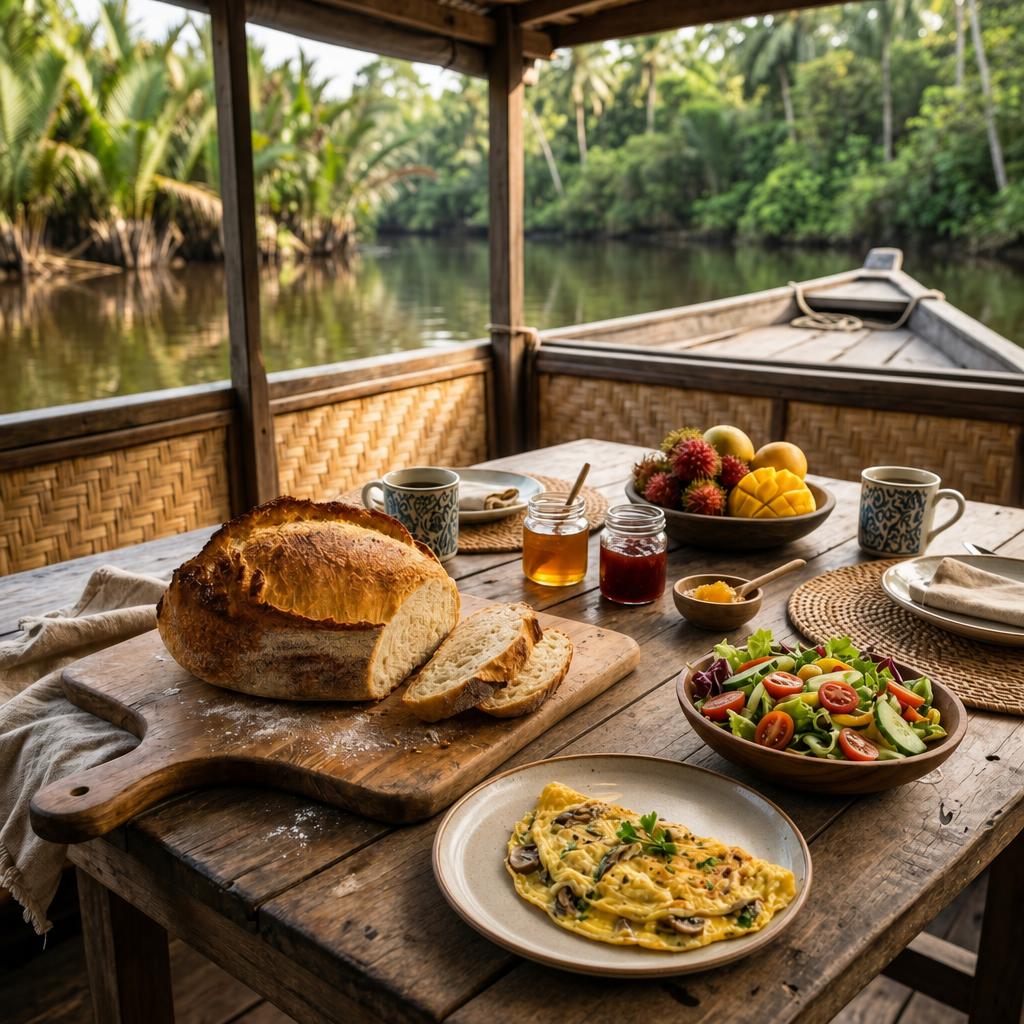
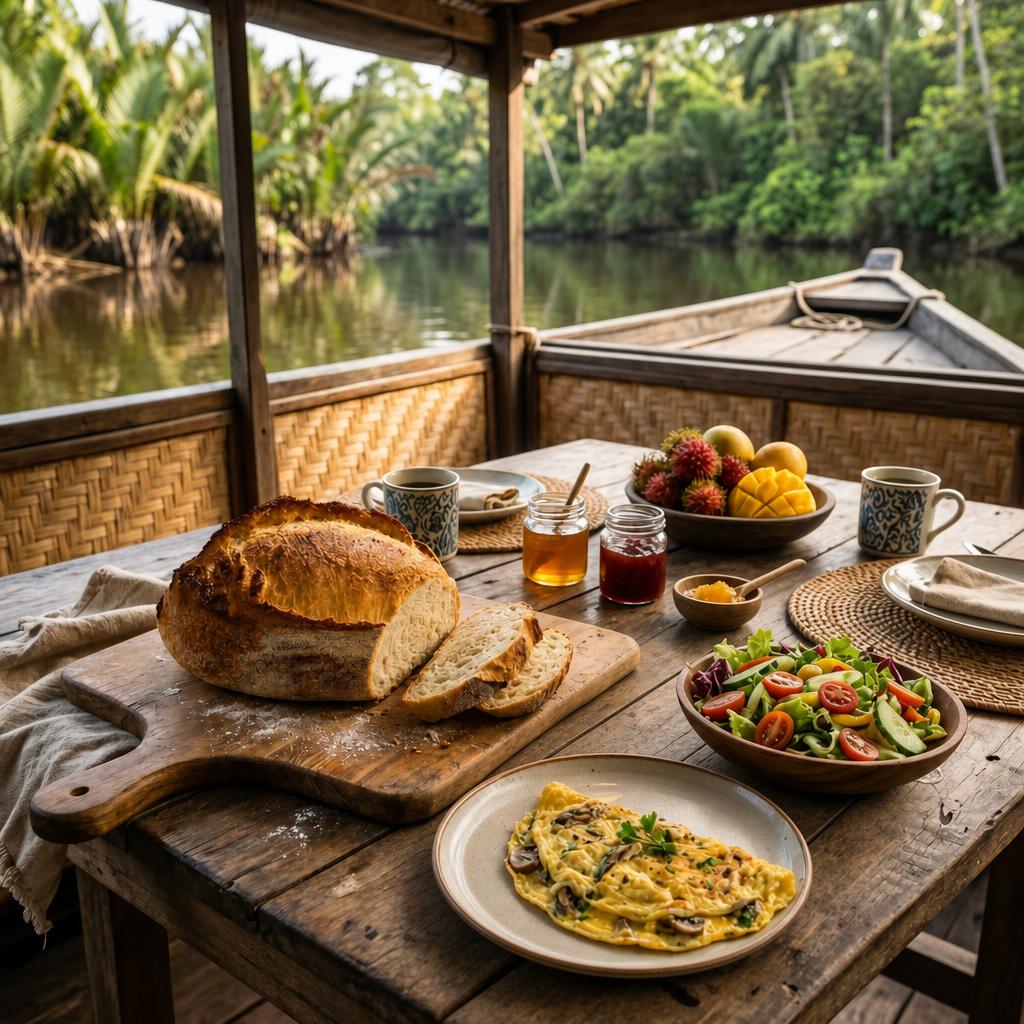
So you travel by klotok: a traditional wooden riverboat, named for the sound its old single-cylinder engine makes, klotok-klotok-klotok, which you'll be hearing in your head for weeks afterwards. The lower deck is engine, kitchen and crew. The upper deck is yours: an open platform with a roof, a table, chairs, and at night a mattress under a mosquito net, with the river a metre below you.
Three things follow from that, and they're the whole argument.
You're inside the park after dark. Day-trippers leave. You don't. Fireflies come out along the bank in numbers that seem invented. Proboscis monkeys crash into the riverside trees at dusk to sleep, because the water gives them a moat against clouded leopards. Somewhere in the black, gibbons start up.
You're not carrying anything. No trekking with a pack in 90% humidity. You sit on a deck at walking pace and the forest slides past two metres away. It is the least athletic way to see serious wildlife that we know of.
You cover ground while you sleep. The boat moors deep in the park overnight and starts the day where the wildlife already is, which is why three days on the water shows you more than three separate day trips ever could.
More on the boats themselves in What Is a Klotok?, including who actually owns them: we charter from local families we've worked with for years rather than running a fleet of our own.
What "seeing an orangutan" actually means here
This is where honest guides and marketing part company, so let's be precise.
Tanjung Puting has three ranger-run viewing sites along the river, where fruit and milk are put out on a platform at a fixed hour: Tanjung Harapan, Pondok Tanggui and Camp Leakey. They exist because of the park's history. Orphaned and confiscated orangutans were rehabilitated and released here over several decades, and the supplementary feeding carried them (and later their wild-born young) through the leaner fruiting months. It is a conservation tool, not a show.
Our three-day, two-night safari visits Tanjung Harapan. That is a deliberate choice, and the reasoning behind it is one of the better stories in this park.
What a platform visit means, honestly:
- The orangutans you see there are wild. Free-ranging, unfenced, living their own lives. Many are the offspring of released animals and have never been handled by anyone.
- They are under no obligation to turn up. In a strong fruiting season the forest offers better food than a platform does, and attendance drops. Nobody controls that, and any promise to the contrary is worth nothing.
- The sightings our guides get most excited about happen away from the platform anyway: from the deck, on the walk in, in a tree nobody was looking at.
So we tell guests to treat the feeding session as the likeliest hour of the day and everything else as a gift. Most trips see orangutans on more than one occasion, along with proboscis monkeys, macaques, hornbills, and gibbons heard long before they're seen. "Most" is the honest word, and we'd rather use it now than have you feel oversold on day two.
Why we don't take the three-day trip to Camp Leakey
Camp Leakey matters. Dr Biruté Galdikas set it up in 1971, and it grew into one of the longest continuous studies of any wild primate anywhere. If you've read a book about orangutans, this is where much of it came from.
The platform there was built as a rehabilitation tool, not an attraction. Orphaned and confiscated orangutans were released here for decades, and the fruit and milk carried them through the lean months. That programme did its job and wound down, and the last releases were in the mid-1990s. What's left is a feeding platform that wild, free-living animals visit when they feel like it, and in a good fruiting season that can mean not at all for weeks. Sightings there are unreliable now.
It does leave us with a choice to make on a short trip. Camp Leakey sits well upriver, and a return run costs the better part of a day in engine noise and transit. We'd rather spend those hours where the wildlife actually is: drifting the narrow stretches with the engine down, walking a forest trail with a guide who knows which tree fruited last week, sitting on deck at the hour the river wakes up. Given three days, that's simply the better use of them, and it's the trip we'd want to be on ourselves.
If Camp Leakey's history is a reason you're coming (for some people it is, and it's a good one), say so when you enquire. We'll build a longer itinerary that gives it the time it deserves rather than squeezing it into a schedule that can't hold it.
A three-day river safari, hour by hour
Here's the shape of the trip most people take, so you can picture it properly. The full version lives on our 3 days / 2 nights klotok safari page.
Day one: into the park. You're met at Pangkalan Bun airport and driven about twenty minutes to Kumai harbour, where your klotok is waiting. Lunch is served on deck as the boat turns off the wide brown Kumai river into the Sekonyer, and within the hour the water darkens to the colour of strong tea: tannin from the peat forest, and the sign that you've crossed into the park proper. Afternoon at the Tanjung Harapan feeding station. Proboscis monkeys gathering in the riverside trees at dusk. Dinner by lamplight, then the night walk if you're up for it: tarantulas, stick insects, sleeping kingfishers. You'll sleep moored to the bank with the mosquito net down and the river making noises you can't identify.
Day two: the forest day. This is the day the trip is built around, and it's deliberately unhurried. Sunrise on deck with coffee and fresh sourdough as the mist lifts off the water. Ours is baked for us by Ninety Degrees Coffee and Sourdough Bakery in Pangkalan Bun, which sounds like an odd thing to mention in a wildlife guide until you've spent three days eating white bread on somebody else's boat. Then the day belongs to the forest: guided walks on the trails, long slow stretches of river with the engine down where the canopy closes overhead, hours of watching rather than travelling. Macaques, hornbills, gibbons calling across the water, and orangutans wherever the forest decides to put them. As the light goes, the firefly cruise: whole riverside trees flickering at once, which is one of those things nobody quite believes until they're sitting in front of it.
Day three: river morning and home. An early start, because the first hour of light is the best wildlife hour of the trip. Birding and gibbon calls in the mist, then a slow cruise back down towards Kumai with brunch on board and a village stop where the timing allows. Airport by early afternoon.
Two nights is the minimum that works properly. One night is a rushed sample of a place that rewards patience. Three nights is genuinely better if you have the days: it opens up the quieter upper river, takes all the schedule pressure off, and is where Camp Leakey can be added for people who want it.
When to go
There's no closed season and no month with no orangutans. There are trade-offs.
Roughly June to September is the drier stretch: easier walking, fewer afternoon downpours, more comfortable nights. August is the driest month, at about 105 mm. Note that May is often sold as dry and isn't: it gets around 211 mm, nearly twice August. It's also the busiest, with July and August the peak, and the platforms have the most people around them.
Roughly October to May is wetter, peaking in April at about 313 mm. Rain here tends to arrive as a heavy afternoon burst rather than a grey all-day drizzle, and the river runs higher, which opens up narrow channels a low river closes off. Far fewer boats. Green everywhere.
The variable that actually changes your sightings isn't rain, it's fruit. When the forest is fruiting heavily, wild orangutans stay in the canopy and skip the free bananas. Nobody publishes a fruiting calendar because it isn't that predictable. We go through the month-by-month detail, including insect levels and river conditions, in Best Time to Visit Tanjung Puting.
Getting there, briefly
Fly to Pangkalan Bun (PKN) in Central Kalimantan. Daily connections run from Jakarta, Surabaya and Semarang, and that's the whole trick: most people assume Borneo is complicated to reach and it's a domestic hop from Java. From the airport it's about twenty minutes by road to Kumai, and the boat leaves from there.
Give yourself a buffer night in Jakarta, Bali or Surabaya on the way in if your international flight is tight; PKN's schedule is thin enough that a missed connection costs you a day of your trip. The routes, timings and what to do if flights shift are in How to Get to Tanjung Puting.
Park permits, ranger fees and guide registration are handled by your operator. You shouldn't be queueing for paperwork on your holiday, and with us you won't be.
What it costs, roughly
A private klotok with crew, guide, all meals, park fees and transfers is the standard package, and it's genuinely all-in: there's very little left to pay once you're on the water, which is one of the quiet pleasures of the trip.
Price moves on three things: how many nights, how many people share the boat, and the standard of the boat itself. Two people on a private boat pay considerably more per head than four or six on the same boat, because the boat and crew cost what they cost. If you're travelling as a pair and want to keep it down, tell us. That's a solvable problem.
We publish an honest breakdown of where the money goes, and what to ask any operator so you can compare quotes properly, in How Much Does a Tanjung Puting Tour Cost? Net rates for agents are available on request.
The rules we keep on the river
If you take one thing from this page, make it this part.
Ten metres minimum from any orangutan, always. They share enough of our biology to catch our illnesses, and a human respiratory infection can kill one. If an animal approaches you, you move back, not because it's dangerous, but because tolerance of humans is a habit we shouldn't be teaching.
No feeding, no touching, no selfies with wildlife, ever. Flash off. Voices down. Nothing goes in the river, and everything that came onto the boat leaves on the boat.
Mask up if you have a cough. We carry them. We've asked guests to skip a feeding session over a cold before, and we'll do it again.
These aren't box-ticking rules. They're the difference between tourism that funds this forest and tourism that erodes it. Our full position, including where the money actually goes, is in Is Orangutan Tourism Ethical?
Frequently asked questions
Can I see orangutans in the wild without a guide? No. Tanjung Puting requires a licensed guide and park permits, and access is by boat only. That's a good thing: it's what keeps visitor numbers and behaviour under control.
Are the orangutans at Tanjung Puting really wild? Yes. They're free-ranging and unfenced. Some are descended from rehabilitated animals released decades ago, and the park provides supplementary food at three platforms, but nothing is enclosed and no animal is required to appear.
Does your three-day trip visit Camp Leakey? No, and it's a deliberate decision. Camp Leakey's rehabilitation programme wound down in the mid-1990s, and the platform there is now visited by wild, free-living orangutans when they feel like it, which in a good fruiting season can mean not at all for weeks. Sightings there are unreliable. Reaching it also costs the better part of a day in transit. On a three-day trip we'd rather spend those hours in the forest and on the water where wildlife is more active. If Camp Leakey's history matters to you, tell us and we'll build a longer itinerary around it.
What are my chances of seeing one? High, but not certain, and we won't put a number on it. Most guests on a two-night trip see orangutans on more than one occasion. Fruiting season, weather and luck all play a part.
Is it safe? Yes, with normal sense. The risks worth planning for are heat, sun and mosquitoes rather than animals. Talk to a travel clinic about malaria prophylaxis and routine vaccinations before you come.
How physically demanding is it? Not very. You sit on a boat most of the time. The walks to feeding platforms are flat, shaded and usually 15 to 30 minutes each way, though the humidity makes anything feel harder than it is. Guests in their seventies do this trip regularly.
Can children come? Yes, and they tend to love the boat as much as the wildlife. Confident swimmers or not, life jackets are on board for everyone.
Is Borneo or Sumatra better for seeing orangutans? Borneo has more orangutans and easier viewing. Sumatra offers closer, more strenuous trekking encounters. For a first trip, Borneo is the more forgiving choice.
How many days do I need? Three days and two nights is the sensible minimum. Four days and three nights is better: more upper river, more time in the forest, and room to include Camp Leakey if you want it. One day is not really worth the flights.
Ready when you are
We run small trips on chartered local klotoks with crews we know by name, into a forest that still has something worth protecting in it. If you want us to look at dates, tell us roughly when and how many, and we'll come back with something specific rather than a brochure.
Meet the Wild, Protect the Wild.
15+ years managing international ecotourism expeditions and conservation operations.
PLAN YOUR SAFARI
Ready to meet the real Borneo?
Nothing is charged until we confirm availability - tell us your dates and we take it from there.
Browse the trips